What we miss when certainty replaces curiosity
Once, at a table full of artists, I said Leonardo da Vinci might have embraced AI.
The room decided before I finished the sentence. Nobody needed to confer. The verdict showed up in their faces first and in words second, and the words were some version of: absolutely not, and how could you.
I didn't argue. I can't know what Leonardo would have done, and neither could anyone at that table. But I had a specific Leonardo in mind, and it wasn't the one on the museum postcard. It was the one who dissected cadavers to see how a hand worked. He filled notebooks with birds, and then with machines that might let a man fly like one. He designed canals and weapons and a mechanical lion alongside the paintings. That Leonardo, I suspect, would have wanted to take the thing apart.
What stayed with me on the drive home wasn't that the artists disagreed. Disagreement is fine. It was how certain the table was about the conclusions of a man who spent his life refusing to settle on any. We remember the masterpieces so clearly that we lose the restlessness behind them. Then we recruit him to defend a line he never stayed behind.
Recently I found myself in the same room again, only bigger. I wrote a short post comparing today's criticism of AI with the old criticism of photography, and the comment section did what comment sections do. Some of it was the best kind of pushback. People asked about consent and compensation, about whose work trained these systems, and about what an artist gives up when a machine makes the decisions. Those questions are real and unsettled, and I'm not going to pretend otherwise.
But something else ran underneath them: a confidence about what a new medium can never become.
That confidence has a history. It also has a poor record.
In 1859, Baudelaire warned that photography, if it were allowed to stand in for art, would corrupt it. Photography should serve the sciences, he wrote, and stay in its place. Fifteen years later, a group of painters who couldn't get past the official Salon hung their own show in a photographer's former studio in Paris. A critic borrowed the title of one of Monet's canvases, Impression, Sunrise, and used it as an insult. The paintings were unfinished, he said, mere impressions. The name stuck, and the insult became a movement.
In 1911, Franz Marc painted horses blue. Horses aren't blue. He had simply stopped believing that color owed anything to the visible world. For him blue carried something spiritual that no accurate brown could. The Blue Rider artists took the same position: a departure from reality could hold more human meaning than a faithful copy.
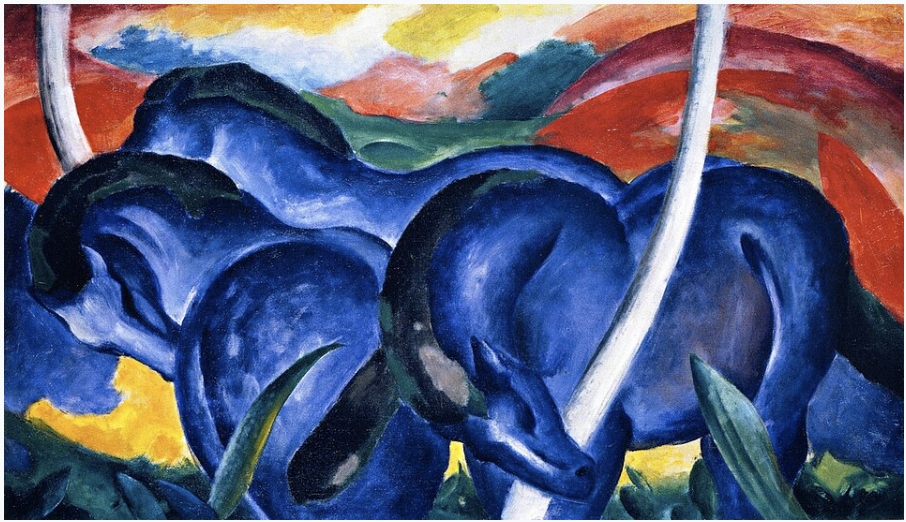
Franz Marc, The Large Blue Horses, 1911
This isn't the same as typing a prompt. Marc made every decision and applied every stroke. I'm not claiming the cases are equal. I'm claiming the reflex is familiar: we measure a new thing against the old rules and declare it isn't art because it fails them.
Then, in 1917, a urinal signed "R. Mutt" arrived at a New York exhibition that had promised to show anything an artist paid to submit. The committee hid it anyway. Fountain is usually credited to Marcel Duchamp. Some historians now argue it began with the Baroness Elsa von Freytag-Loringhoven, which only proves the point. Either way, it asked a question the art world is still arguing about. Does the artist have to make the thing by hand? Or can the art live in the choosing, the framing, the intention, and the encounter with whoever stands in front of it?
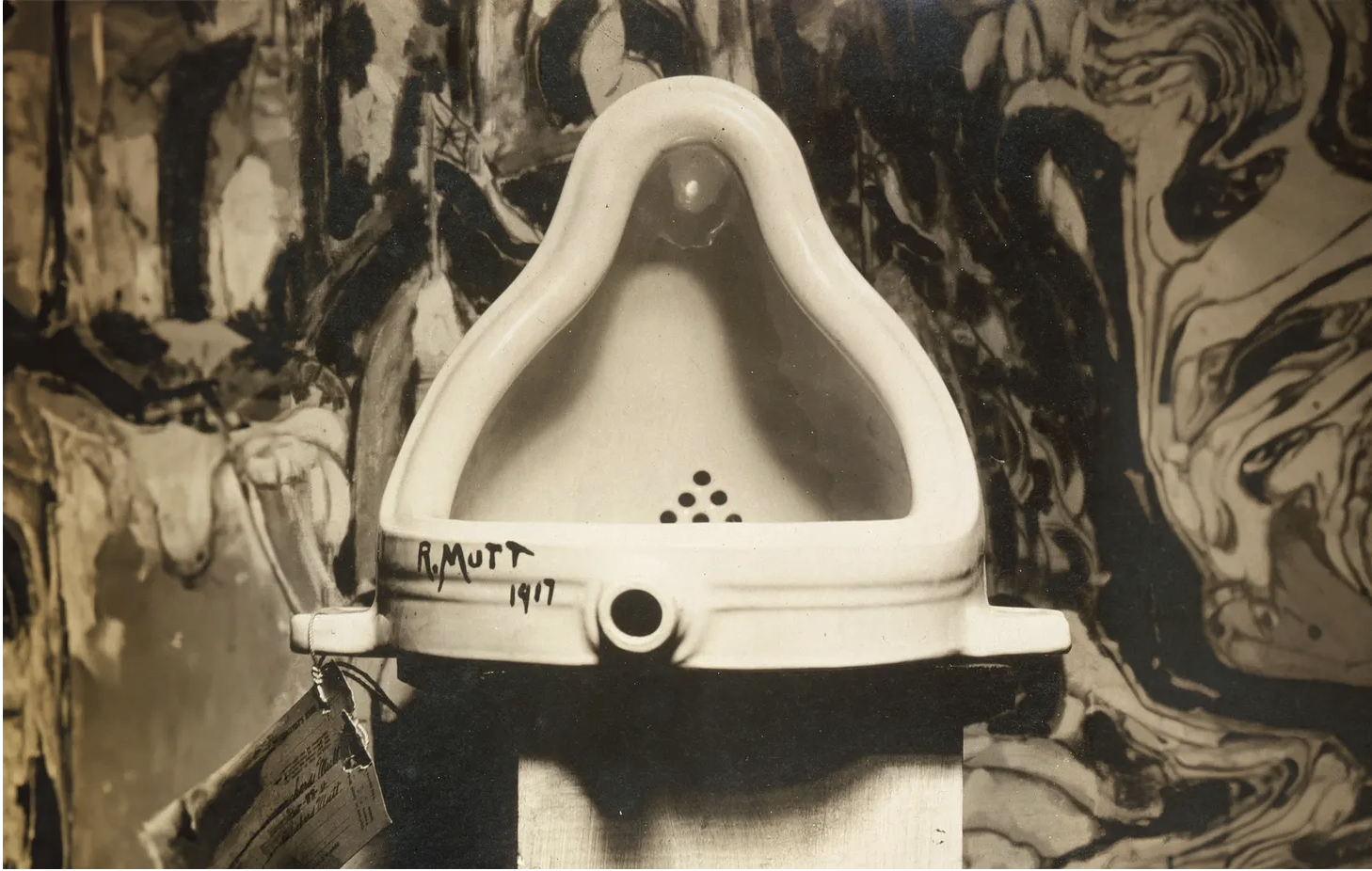
Marcel Duchamp, Fountain, 1917. Photograph by Alfred Stieglitz.
AI doesn't answer that question. It makes it harder. A system trained on millions of human images can now generate its own and make choices an artist would otherwise make. So the right questions get sharper, not softer. How much did the person contribute? What were they trying to say? Whose work made the system possible, and were they asked?
Those are questions. "It's artificial" is not a question. It's a verdict dressed up as one.
Paint is a technology. So are the camera, the synthesizer and the pencil. Each one helped people say things that mattered, and each was suspected at first of saying nothing at all. AI's larger hand in producing the result deserves more scrutiny than paint ever got. But scrutiny is not the same as a ruling handed down before the work exists.
I grew up in Mojave, where "experimental" is an actual category on an aircraft's paperwork. It doesn't mean approved, and it doesn't mean doomed. It means we don't know yet, so we're going to watch it fly. I'd like a little of that category in art. My guess is that artists will make serious work with AI, against AI and about AI, and that some of the most interesting work will refuse to pick one. Whether any of it becomes a movement will depend on what those artists have to say. It always has.
I understand why the room closes ranks. I'm a writer. I've spent years learning to do something a machine now approximates in seconds, and I feel that too. Disagreement isn't fear. Curiosity isn't approval.
But defending a definition is not the same as examining it. Every movement in this essay began with someone willing to examine while the room was busy defending.
So here's the question I keep bringing home from that table: if Leonardo walked in tomorrow, would we ask him what he thought, or would we tell him?